






Living in Teton Valley means beautiful country and a little distance from everything else. For a long time, that distance made a lot of people assume satellite was their only real option for internet. That’s changing fast; fiber is here, and in more of the valley every build season. Here’s how the two technologies actually work, and why, when a fiber line reaches your address, it’s the stronger choice.
How Fiber Works: Sending Light Down a Glass Thread
Fiber-optic internet carries your data as pulses of light traveling through strands of glass thinner than a human hair. Those strands are bundled in a protected cable that runs underground or on poles, right to your home. The light bounces along the inside of the glass like a beam ricocheting down a mirrored hallway, moving at close to the speed of light.
The analogy: Fiber is a private, dedicated highway built straight to your front door. It goes directly where it needs to go, it has plenty of lanes for heavy traffic (multiple devices, 4K streaming, big uploads), and – this matters in Teton Valley – it doesn’t get snowed out. A blizzard doesn’t touch it.

How Satellite Works: Bouncing a Signal Off the Sky
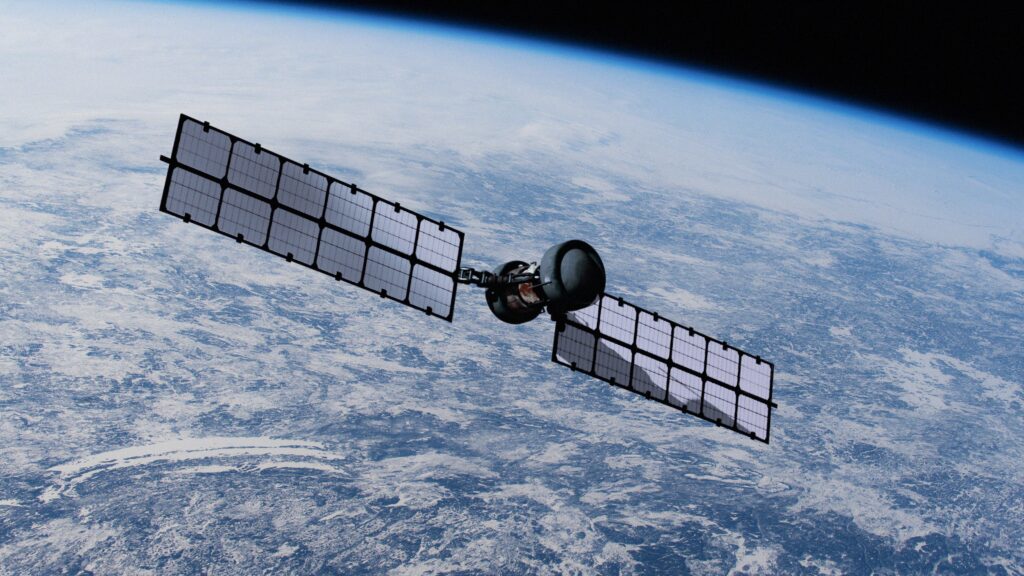
Satellite skips the wire. A dish at your home sends radio signals up to satellites orbiting the Earth, over to a ground station wired into the internet, and back down again. Newer systems like Starlink use satellites only a few hundred miles up, which shortens the trip compared to older satellites parked 22,000 miles out.
The analogy: Satellite is less like a road and more like a courier flying by helicopter. It can reach places no road ever will: a cabin at the end of a long dirt drive, a ranch well outside town. That reach is a genuine strength. However, the courier must fly up and back for every delivery, which adds lag, the uploads are weaker than the downloads, and heavy weather can ground the flight.
Why Fiber Wins in a Place Like Teton Valley
The gap between the two shows up most in exactly the conditions we live with here:
| Fiber | Satellite | |
| Winter | Buried glass: snow and cold don’t affect it | Dish can be blocked or slowed by heavy snow |
| Working from home | Uploads match downloads: smooth video calls, fast file sending | Uploads noticeably weaker; can strain calls and backups |
| Lag (latency) | Very low: great for calls, gaming, live anything | Higher; the signal still has a round trip to make |
| Consistency | Steady, even at peak evening hours | Shared with other users in the area; can dip when busy |
If you moved to the valley to live somewhere beautiful and keep working (video calls with clients, uploading big files, running a household full of devices, etc.) the difference isn’t small. That symmetrical upload and low lag is where fiber pulls clearly ahead.
The Bottom Line
Satellite earned its place for the truly off grid, where no cable will ever run, but you may not need to settle for a signal bouncing off the sky. Where a Silver Star fiber line reaches your home, you get a direct, snow-proof connection with the lowest lag and uploads as strong as your downloads, built right here in the valley we’ve served for over a century.
The fastest way to know your options is to check your address and see if fiber has reached you yet.